

Amours de Voyage by Arthur Hugh Clough
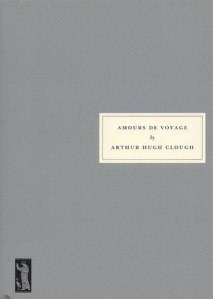
Blurb
Amours de Voyage is a novel in verse and is arranged in five cantos, or chapters, as a sequence of letters. It is about a group of English travellers in Italy: Claude, and the Trevellyn family, are caught up in the 1849 political turmoil. The poem mixes the political (‘Sweet it may be, and decorous, perhaps, for the country to die; but,/On the whole, we conclude the Romans won’t do it, and I sha’n’t’) and the personal (‘After all, do I know that I really cared so about her?/Do whatever I will, I cannot call up her image’). The political is important but the personal dilemmas are the crucial ones.
Claude, about to declare himself, retreats, regrets. It is this retreat, his scruples and fastidiousness, that, like a conventional novel, is the core of Amours de Voyage. The poem thus contributed something important to the modern sensibility; it is a portrait of an anti-hero; it is about love and marriage (the difficulties of); and it is about Italy.
Review
I had never heard of Arthur Hugh Clough before but I was really intrigued when I saw this book in Persephone books so I bought it. I have been reading some pretty hefty books recently so last weekend I thought I would read a shorter book as a quick read and this was the book I chose.
The first thing I loved about this book was the preface by Julian Barnes. Barnes gave a wonderful description of Clough’s life and the background behind this book. It really set the scene well.
This was quite a different read for me but one that I flew through. I really loved Claude’s thoughts on Rome as he really was very unimpressed with the whole affair and I found his reactions to it quite amusing. The book is a novel in verse and made up of letters. Claude writes to his long suffering friend Eustace and I say long suffering because I think the poor man has a lot of letters of Claude. The other letters are from the Trevellyn sisters to their friend.
I will be honest the character Claude was not my favourite. He found Rome boring, he was self centred, looked down on people and only found Mary interesting when she had gone. Personally I think Mary was better off without Claude in her life. Mary thought a lot more about Claude than Claude did about Mary.
Overall, I loved Clough’s writing and I would love to read more of his work but what let it down for me was simply his main character Claude. I just could not deal with Claude’s selfish behaviour sadly. Due to this I give the book 3 out of 5 Dragons.
🐲🐲🐲
Purchase Links
Book Depository | Bookshop.org | Waterstones | Wordery
(All purchases made using one of the above affiliate links gives a small percentage of money to myself with no extra cost to yourself. All proceeds go towards the upkeep of this blog. Thank you ever so much, your support is gratefully received.)
About the author
Arthur Hugh Clough (1819-1861) was an English poet, an educationalist, and the devoted assistant to Florence Nightingale.




 Lady Book Dragon