Northanger Abbey by Jane Austen (Review)

Northanger Abbey by Jane Austen

Bookshop.org | Ebook | Harper Collins | TG Jones | Waterstones

Blurb

The story’s unlikely heroine is Catherine Morland, a remarkably innocent seventeen-year-old woman from a country parsonage. While spending a few weeks in Bath with a family friend, Catherine meets and falls in love with Henry Tilney, who invites her to visit his family estate, Northanger Abbey. Once there, Catherine, a great reader of Gothic thrillers, lets the shadowy atmosphere of the old mansion fill her mind with terrible suspicions. What is the mystery surrounding the death of Henry’s mother? Is the family concealing a terrible secret within the elegant rooms of the Abbey? Can she trust Henry, or is he part of an evil conspiracy? Catherine finds dreadful portents in the most prosaic events, until Henry persuades her to see the peril in confusing life with art.

Review

I first read this book back in 2002 and I must admit it wasn’t my favourite Austen novel and is one of the reasons I never bothered to read it again. However, I decided to give it another go this year because I remembered part of it is set in Bath which is one of my favourite places. I absolutely loved the descriptions of places I love in Bath and kept telling my husband where the characters were. 

I am so pleased I decided to give this book another go because I absolutely loved it and couldn’t put it down. Northanger Abbey is a hilarious coming of age and satire novel of the gothic genre. Instead of finding Catherine annoying which I did in my first read I found her adorable, funny and when she let her imagination run away with her I cringed for her but also understood where she had come from. Catherine loved reading novels especially novels by Ann Radcliffe so how could she not help imagining crazy gothic mysteries around every corner. When I read The Mysteries of Udolpho I also saw the potential for  gothic mysteries everywhere. 

Henry Tilney is definitely a new favourite character of mine from the Austen novels. He loves reading novels and doesn’t dismiss Catherine’s love of reading gothic novels like the pompous John Thorpe who I really could not stand. Tilney is a true gentleman, he takes time with Catherine, he listens to her and enjoys her company. He also forgives Catherine’s mistakes. 

Isabella Thorpe is a character much like her brother but it doesn’t become clear straight away. In fact the Thorpe family were just terrible full stop and I could easily see how Austen had been influenced by people she knew in society. The people in society she clearly disliked and had little time for. 

I loved this book and would happily read it again and again. I really appreciated this book more now that I am older. I give this book a massive 5 out of 5 Dragons. 

🐲🐲🐲🐲🐲

About the author

Jane Austen born 16th December 1775 died 18th July 1817 was an English novelist known for her six major novels. Austen’s novels are known for social comedy and accurate depiction of human relationships.

Etsy

If you enjoy reading my blog and would like to make a donation I would be very grateful. Thank you

Review 12: The Heart of a Dog by Mikhail Bulgakov

The Heart of a Dog by Mikhail Bulgakov (Translated by Michael Glenny)

About the author

Mikhail Bulgakov was born in Kiev on 15th May 1891. He trained as a doctor but gave up practising medicine in 1920 to devote his life to writing. In 1925 he completed The Heart of a Dog, which remained unpublished in the Soviet Union until 1987. By 1930 Bulgakov had become so frustrated by the suppression of his work that he wrote to Stalin begging to be allowed to emigrate if he was not given the opportunity to make his living as a writer in the USSR. Stalin telephoned him personally and offered him a job at the Moscow Arts Theatre. In 1938, he completed The Master and Margarita. He sadly died in 1940. In 1973 The Master and Margarita was finally published in full.

Blurb

A rich, successful Moscow professor befriends a stray dog and attempts a scientific first by transplanting into it the testicles and pituitary gland of a recently deceased man. A distinctly worryingly human animal is now on the loose, and the professor’s hitherto respectable life becomes a nightmare. An absurd and superbly comic story, this novel can also be read as a fierce parable of the Russian Revolution.

Review

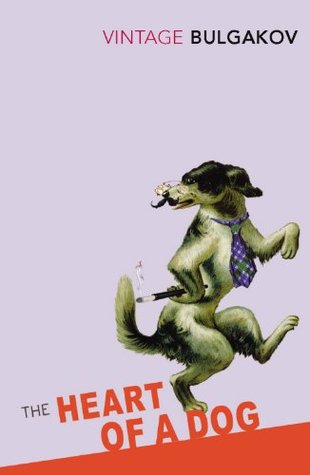
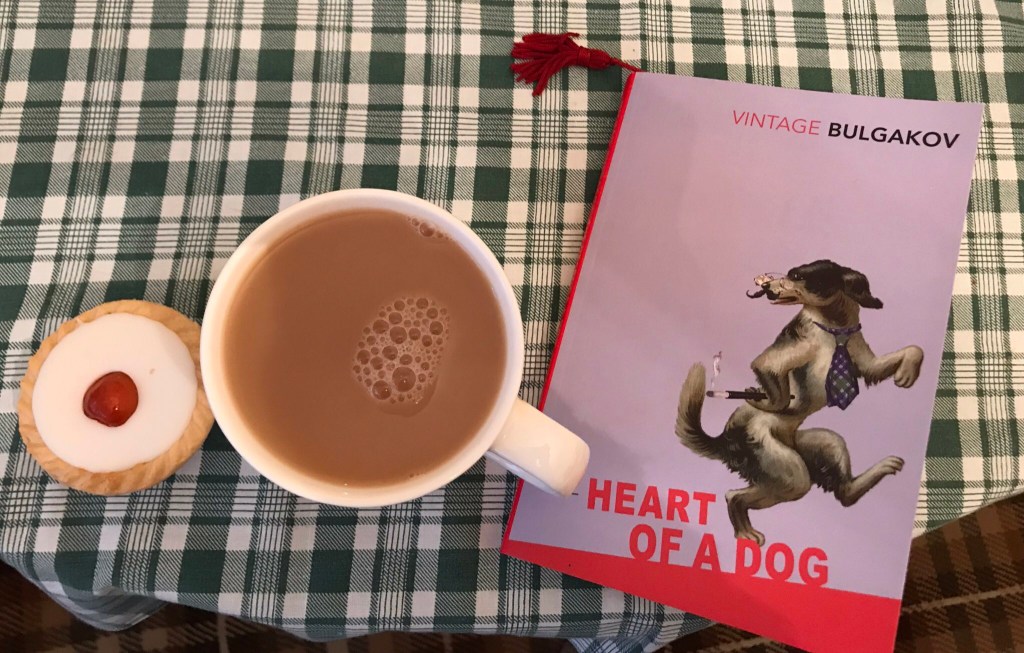
This book was on a table in the Waterstones in London and I must admit I was intrigued. I do find the piles of books on the tables at Waterstones very tempting and I often end up buying books I usually would not go for. Having read a few books with cats on the cover recently I thought it was about time I read a book with a dog on the front. Sadly I found this book rather a disappointment. 

Firstly, I have not read The Master and Margarita but it is on my to read pile and even though this book has been a disappointing read for me, I will give The Master and Margarita a chance and keep it on my to read pile. I do not regret reading this book, as it was interesting and I did enjoy small parts of it. 

The story begins with the meeting of the stray dog and the dog’s thoughts. The poor dog has been badly wounded and is contemplating its end and the reader gets to see the world of Russia through its eyes. Then Professor Philip Philipovich comes on to the scene and befriends the wounded dog. This Professor takes the stray into his home, treats his wounds and appears to be a dream come true for the dog. The dog’s world has changed for the better and it is glorious, until it all changes and the Professor’s true intentions become clear.

The Professor specialises in rejuvenating people’s sexual organs by replacing them with animal organs. This becomes clear when he examines a lady and says he will replace her ovaries with the ovaries of a monkey. This to be honest disturbed me when I read it and I was dubious whether to continue, as things like that quite often put me off, but by this point I had fallen in love with the little dog and wanted to know what would happen to him next.

The graphic detail of the surgery really put me off and I must admit I had to skim some of the details as I could not handle it, especially just before sleep. It was extremely realistic and this is obviously where Bulgakov’s medical background comes in handy when writing about the surgery. Again I only kept going because I desperately wanted to know what would happen next to the dog.

The descriptions of the way Soviet Russia was becoming was very interesting and I can see how worrying it would have been for the people living in Russia at the time it was all happening. I can also see why the book was confiscated from Bulgakov, because the last thing the Soviet Union would have wanted was this bleak view of Russia being broadcast to the world. I think the stray dog’s point of view whilst in the doorway waiting for death was the best description of Russia and really summed up what Bulgakov was trying to get across. 

However as the story went on, I just think it went somewhat off the rails and a bit too over the top for me. Also Philip started to drive me slightly crazy with his constantly quoting from the theatre for example “To the banks of the sacred nile…” it was like the man was demented and just made no sense. 

The dog as a normal dog was the best part of this book and I just could not understand why a man would want to perform the experiment that he did to the dog. Maybe it is because I have no real interest in science but it just did not make sense. Frankenstein made sense to me because the good doctor was trying to find a cure for death but putting the testicles and pituitary gland of a human into a dog made no sense at all to me. 

As a Russian book I was surprised at how short it was, my general experience of Russian literature is of huge tomes, some of which are my favourite books. Shortness for this book was one of its advantages though.

I do not think my review of this book will be popular as I tend to be against the general consensus but my views are my own and everyone has their own opinions, which is good as we would be a pretty boring race if we all felt and thought the same. My overall rating of the book is 2 stars out of 5, the reason it was not 1 star was because I liked the beginning a great deal and the dog before it all went wrong. 

A quick read to while away an afternoon break like I used it for.

Lady Book Dragon