I hope everyone has had a good week so far and have some good plans for the weekend.
My chosen poem for this week is by another new poet for me, Sergei Yesenin. Yesenin (1895-1925) was a Russian lyric poet.
The Birch Tree

Under my window
Tucked in the snow
White birch retired
Clad in silver glow.

On the fluffy branches
Snowy-trim with silver-tinge
Melted around catkins
Forming white fringe.

Like golden fires
Snow-flakes blazed
While birch stood still
Asleep, or amazed.

Meanwhile, lazily
Strolling around,
Dawn threw more 'silver'
On the twigs (and ground).

Sergei Yesenin
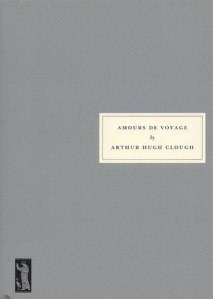
Amours de Voyage is a novel in verse and is arranged in five cantos, or chapters, as a sequence of letters. It is about a group of English travellers in Italy: Claude, and the Trevellyn family, are caught up in the 1849 political turmoil. The poem mixes the political (‘Sweet it may be, and decorous, perhaps, for the country to die; but,/On the whole, we conclude the Romans won’t do it, and I sha’n’t’) and the personal (‘After all, do I know that I really cared so about her?/Do whatever I will, I cannot call up her image’). The political is important but the personal dilemmas are the crucial ones.
Claude, about to declare himself, retreats, regrets. It is this retreat, his scruples and fastidiousness, that, like a conventional novel, is the core of Amours de Voyage. The poem thus contributed something important to the modern sensibility; it is a portrait of an anti-hero; it is about love and marriage (the difficulties of); and it is about Italy.
Review
I had never heard of Arthur Hugh Clough before but I was really intrigued when I saw this book in Persephone books so I bought it. I have been reading some pretty hefty books recently so last weekend I thought I would read a shorter book as a quick read and this was the book I chose.
The first thing I loved about this book was the preface by Julian Barnes. Barnes gave a wonderful description of Clough’s life and the background behind this book. It really set the scene well.
This was quite a different read for me but one that I flew through. I really loved Claude’s thoughts on Rome as he really was very unimpressed with the whole affair and I found his reactions to it quite amusing. The book is a novel in verse and made up of letters. Claude writes to his long suffering friend Eustace and I say long suffering because I think the poor man has a lot of letters of Claude. The other letters are from the Trevellyn sisters to their friend.
I will be honest the character Claude was not my favourite. He found Rome boring, he was self centred, looked down on people and only found Mary interesting when she had gone. Personally I think Mary was better off without Claude in her life. Mary thought a lot more about Claude than Claude did about Mary.
Overall, I loved Clough’s writing and I would love to read more of his work but what let it down for me was simply his main character Claude. I just could not deal with Claude’s selfish behaviour sadly. Due to this I give the book 3 out of 5 Dragons.
(All purchases made using one of the above affiliate links gives a small percentage of money to myself with no extra cost to yourself. All proceeds go towards the upkeep of this blog. Thank you ever so much, your support is gratefully received.)
About the author
Arthur Hugh Clough (1819-1861) was an English poet, an educationalist, and the devoted assistant to Florence Nightingale.
I hope you all have some fab plans for the weekend. I am rather gloomy now the Christmas decorations have come down as I always find the house so bare and dull once the pretty decorations are taken down.
My chosen poem today is from a new poet for me. Sara Coleridge (1802-1852) was a translator, novelist and poet. Coleridge hailed from a very literary family, her father was the early Romantic poet Samuel Taylor Coleridge. Her uncle was the Poet Laureate Robert Southey and her neighbour was William Wordsworth. Coleridge was surrounded by talented poets.
The Garden Year

January brings the snow,
Makes our feet and fingers glow.

February brings the rain,
Thaws the frozen lake again.

March brings breezes, loud and shrill,
To stir the dancing daffodil.

April brings the primrose sweet,
Scatters daises at our feet.

May brings flocks of pretty lambs
Skipping by their fleecy dams.

June brings tulips, lilies, roses,
Fills the children's hands with posies.

Hot July brings cooling showers,
Apricots, and gillyflowers.

August brings the sheaves of corn,
Then the harvest home is borne.

Warm September brings the fruit;
Sportsmen then begin to shoot.

Fresh October brings the pheasant;
Then to gather nuts is pleasant.

Dull November brings the blast;
Then the leaves are whirling fast.

Chill December brings the sleet,
Blazing fire, and Christmas treat.

Sara Coleridge
I hope you are all looking forward to New Year and have some fun plans for New Year’s Eve. We will probably have a quiet New Year’s Eve at home but we have a nice bottle of champagne to help us celebrate.
My chosen poem today is by one of my favourites Eleanor Farjeon.
Poetry

What is Poetry? Who knows?
Not a rose, but the scent of a rose;
Not a sky, but the light in the sky;
Not the fly, but the gleam of the fly;
Not the sea, but the sound of the sea;
Not myself, but what makes me
See, hear, and feel something that prose
Cannot: and what it is, who knows?

Eleanor Farjeon
I hope everyone is ready for Christmas. My chosen poem today is a favourite of mine by Cicely Mary Barker.
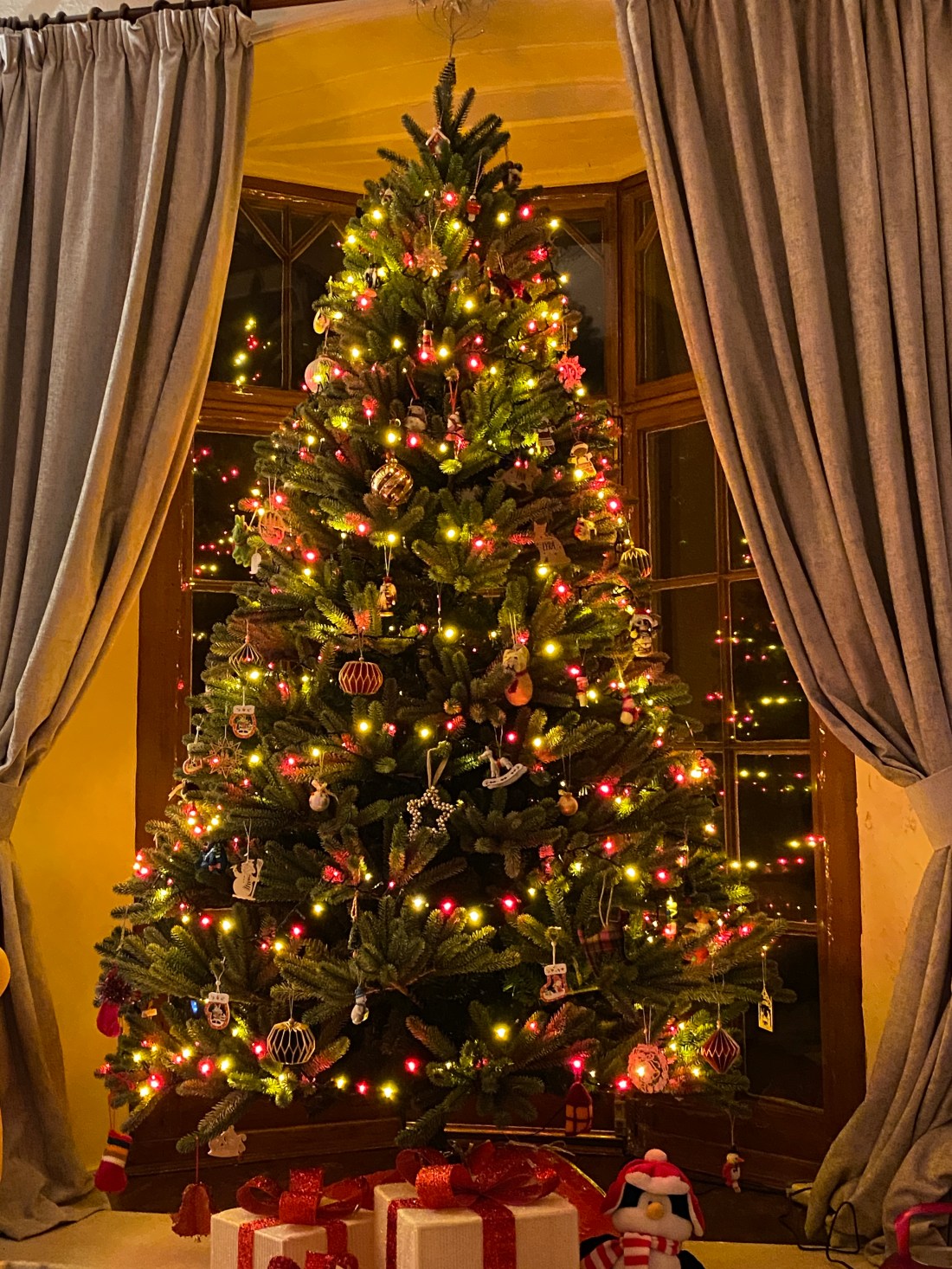
Sadly our tree won’t have a Christmas Tree fairy living in it because our tree is artificial, this is mainly because my husband and myself are both allergic to real Christmas trees.
The Christmas Tree Fairy

The little Christmas Tree was born
And dwelt in open air;
It did not guess how bright a dress
Some day its boughs would wear;
Brown cones were all, it thought, a tall
And grown-up Fir would bear.

O little Fir! Your forest home
Is far and far away;
And here indoors these boughs of yours
With coloured balls are gay,
With candle-light, and tinsel bright,
For this is Christmas Day!

A dolly-fairy stands on top,
Till children sleep; then she
(A live one now!) from bough to bough
Goes gliding silently.
O magic sight, this joyous night!
O laden, sparkling tree!

Cicely Mary Barker
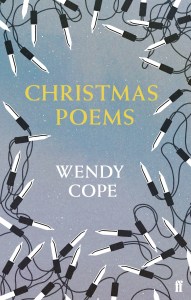
For more than thirty years Wendy Cope has been one of the nation’s most popular and respected poets. Christmas Poems collects together her best festive poems, including anthology favourites such as ‘The Christmas Life’, together with new and previously unpublished work. Cope celebrates the joyful aspects of the season but doesn’t overlook the problems and sadness it can bring. With lively illustrations to accompany the words, it is a book to enjoy this Christmas and in years to come.
Review
I bought this book in October when I was in Bath and I was really excited because I thought this little book would be a perfect festive read in December. At only 48 pages long this did not take me long to read and was a perfect diversion from the Christmas prep.
As you probably know by now if you have been following me for any length of time I was never a huge poetry fan but since I have been blogging I have been making an effort to get into poetry. Since doing this I have found quite a few favourite poets that I enjoy to read and I am always looking for new poets to read. Wendy Cope is one of these new poets for me.
Certain poems within this book I could really relate to. Cope was a primary school teacher for 15 years and a piano player and her reflections on playing for children’s services I can relate to as I teach piano and woodwind in a primary school and know all about the Christmas services and the many renditions of Little Donkey.
I will be honest there were only a few poems that I really enjoyed in this book because I found quite a few of the poems rather depressing and not very helpful for getting into the festive spirit. However, I like Cope’s style as a poet and will definitely be checking out more of her poems.
The illustrations in this book are by Michael Kirkham and were excellent and really added to the poems. Without the illustrations the book would have been a lot shorter.
Overall, I found this little book of poems an accomplished read but not really my cup of tea. It sadly wasn’t the festive read I was looking for but I appreciate the skill of Wendy Cope. I give this book 3 out of 5 Dragons.
(All purchases made using one of the above affiliate links gives a small percentage of money to myself with no extra cost to yourself. All proceeds go towards the upkeep of this blog. Thank you ever so much, your support is gratefully received.)
About the poet
Wendy Cope was educated at Farringtons School, Chislehurst, London and then, after finishing university at St Hilda’s College, Oxford, she worked for 15 years as a primary school teacher in London.
In 1981, she became Arts and Reviews editor for the Inner London Education Authority magazine, ‘Contact’. Five years later she became a freelance writer and was a television critic for ‘The Spectator magazine’ until 1990.
Her first published work ‘Across the City’ was in a limited edition, published by the Priapus Press in 1980 and her first commercial book of poetry was ‘Making Cocoa for Kingsley Amis’ in 1986. Since then she has published two further books of poetry and has edited various anthologies of comic verse.
In 1987 she received a Cholmondeley Award for poetry and in 1995 the American Academy of Arts and Letters Michael Braude Award for light verse. In 2007 she was one of the judges for the Man Booker Prize.
In 1998 she was the BBC Radio 4 listeners’ choice to succeed Ted Hughes as Poet Laureate and when Andrew Motion’s term of office ended in 2009 she was once again considered as a replacement.
She was awarded the OBE in the Queen’s 2010 Birthday Honours List.
I hope everyone is having a good week so far and you all have exciting weekend plans. I will be honest December is not proving to be our best month. I have spent most of the week without a car and just because I have a hugely busy weekend of playing jobs my car is still not fixed so I will have to borrow my Mom’s car. This will be the first time ever my Mom will have let me drive her car.
As we get closer to Christmas I have decided to go for a Christmas themed poem.
Mary's Burden

My Baby, my Burden,
Tomorrow the morn
I shall go lighter
And you will be born.

I shall go lighter,
But heavier too
For seeing the burden
That falls upon you.

The burden of love,
The burden of pain,
I'll see you bear both
Among men once again.

Tomorrow you'll bear it
Your burden alone,
Tonight you've no burden
That is not my own

My Baby, my Burden,
Tomorrow the morn
I shall go lighter
And you will be born.

Eleanor Farjeon
My chosen poem today is only a short one but it is by my all time favourite poet and I do find the poem rather thought provoking.
What Are Heavy?

What are heavy? Sea-sand and sorrow:
What are brief? To-day and to-morrow:
What are frail? Spring blossoms and youth:
What are deep? The ocean and truth.

Christina Rossetti
I hope everyone has had a good Friday so far and have some exciting plans for the weekend. My chosen poem today is by one of favourites, Thomas Hardy.
Birds at Winter Nightfall

Around the house the flakes fly faster,
And all the berries now are gone
From holly and cotoneaster
Around the house. The flakes fly! - faster
Shutting indoors that crumb-outcaster
We used to see upon the lawn
Around the house. The flakes fly faster,
And all the berries now are gone!

Thomas Hardy
The poem I have chosen for today is a new poet for me. Harold Munro (1879-1932) was an English poet. As the owner of the Poetry Bookshop in London, he helped many poets to get their poetry into the public light.
Overheard on a Saltmarsh

Nymph, nymph, what are your beads?
Green glass, goblin. Why do you stare at them?
Give them me.

No.

Give them me. Give them me.

No.

Then I will howl all night in the reeds,
lie in the mud and howl for them.

Goblin, why do you love them so?

They are better than stars or water,
Better than voices of winds that sing,
Better than any man's fair daughter,
Your green glass beads on a silver ring.

Hush, I stole them out of the moon.

Give me your beads, I want them.

No.

I will howl in a deep lagoon
For your green glass beads, I love them so.
Give them me. Give them.

No.

Harold Munro




 Lady Book Dragon