

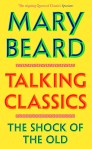
Talking Classics: The Shock of the Old by Mary Beard
Bookshop.org | Ebook | TG Jones | Waterstones | World of Books
Blurb
FROM THE BESTSELLING AUTHOR OF EMPEROR OF ROME AND SPQR ‘The rock star scholar of Ancient Rome’ FINANCIAL TIMES
‘The reigning Queen of Classics’ SPECTATOR What’s exciting about a piece of bread 4,000 years old? Or some pots of paint abandoned in the eruption at Pompeii? Why should we be bothered with the distant past anyway? What’s the point? The life, art and literature of ancient Greece and Rome have something to offer everyone. They are not the property of wealthy white men only. They make us wonder how to make sense of people who lived long ago (from angry landlords to giggling senators) – and to think harder about our own world, to look at it differently. In Talking Classics, Mary Beard points to the surprising connections between antiquity and the present. From revolutionaries to dictators, Bob Dylan to Beyoncé, she joins forces with the varied modern characters who have been transfixed by the ancient world. It’s not compulsory, she argues, to be excited by antiquity, but it’s a shame not to be. After half a century teaching and studying classics, she fills the book with lively stories, curious facts and some good gossip. Talking Classics explains why the deep past does really affect us all.
Review
Time for another book review! My reading has definitely slowed down since having my Baby Book Dragon but that is ok because I’m also struggling to find the time to review the books I read!
Anyone who has followed my blog for any length of time knows how much I love my Ancient Greek and Roman history and that I also completed a Masters in Classics during Covid. One of my favourite classicists is Mary Beard and I had this book preordered for many months before it arrived. Strangely for me I also started reading this book as soon as it arrived! It was the perfect book for reading while I was nap trapped and I absolutely loved it.
This isn’t a traditional history book but more like sitting down and listening to Mary Beard think aloud about why the ancient world still matters and is just as relevant today as it was in the past. This for me is what gives this book it’s charm and what made it such an addictive read.
Beard wants classics to shock, to provoke, to appear strange. Beard explores how later generations use Ancient Greece and Rome to their advantage, in politics, art, literature and more. She shows examples of how the classical past has been romanticised.
Beard also gives examples of how the ancient past attracted famous people from the past. I particularly liked reading about Hitler and Mussolini being taken around Rome by the archaeologist Bandinelli. I think I will have to track down a copy of Bandinelli’s memoir of this event as Beard makes it sound like a fascinating read.
However, my favourite part of this book was learning about Beard’s love of classics and how it all started and developed. Beard doesn’t make this book stuffy and academic, it is energetic, funny and knowledgeable. Beard doesn’t place classics on a pedestal but asks us to use them, argue with them, learn from them. I thoroughly enjoyed this book and give it 5 out of 5 Dragons.
About the author
Winifred Mary Beard (born 1 January 1955) is Professor of Classics at the University of Cambridge and is a fellow of Newnham College. She is the Classics editor of the Times Literary Supplement, and author of the blog “A Don’s Life”, which appears on The Times as a regular column. Her frequent media appearances and sometimes controversial public statements have led to her being described as “Britain’s best-known classicist”.
Mary Beard, an only child, was born on 1 January 1955 in Much Wenlock, Shropshire. Her father, Roy Whitbread Beard, worked as an architect in Shrewsbury. She recalled him as “a raffish public-schoolboy type and a complete wastrel, but very engaging”. Her mother Joyce Emily Beard was a headmistress and an enthusiastic reader.
Mary Beard attended an all-female direct grant school. During the summer she participated in archaeological excavations; this was initially to earn money for recreational spending, but she began to find the study of antiquity unexpectedly interesting.
At the age of 18 she was interviewed for a place at Newnham College, Cambridge and sat the then compulsory entrance exam. She had thought of going to King’s, but rejected it when she discovered the college did not offer scholarships to women. Although studying at a single-sex college, she found in her first year that some men in the University held dismissive attitudes towards women’s academic potential, and this strengthened her determination to succeed. She also developed feminist views that remained “hugely important” in her later life, although she later described “modern orthodox feminism” as partly “cant”. Beard received an MA at Newnham and remained in Cambridge for her PhD.
From 1979 to 1983 she lectured in Classics at King’s College London. She returned to Cambridge in 1984 as a fellow of Newnham College and the only female lecturer in the Classics faculty. Rome in the Late Republic, which she co-wrote with the Cambridge ancient historian Michael Crawford, was published the same year. In 1985 Beard married Robin Sinclair Cormack. She had a daughter in 1985 and a son in 1987. Beard became Classics editor of the Times Literary Supplement in 1992.
In 2004, Beard became the Professor of Classics at Cambridge. She is also the Visiting Sather Professor of Classical Literature for 2008–2009 at the University of California, Berkeley, where she has delivered a series of lectures on “Roman Laughter”.




